Reviewed: September 2026
Written by Aviva Alyeshmerni, MD, MS, FAAP
Board-certified pediatrician since 2009 | Stanford BS and MS | Sackler School of Medicine (Tel Aviv University) MD | UC Irvine Pediatric Residency | Castle Connolly Top Doctor (2016–2026) | Orange Coast / OCMA Physician of Excellence (2025–2027) | Concierge pediatrician in Newport Beach, CA since 2016 | Former Cross Country Running Coach and Stanford Athlete
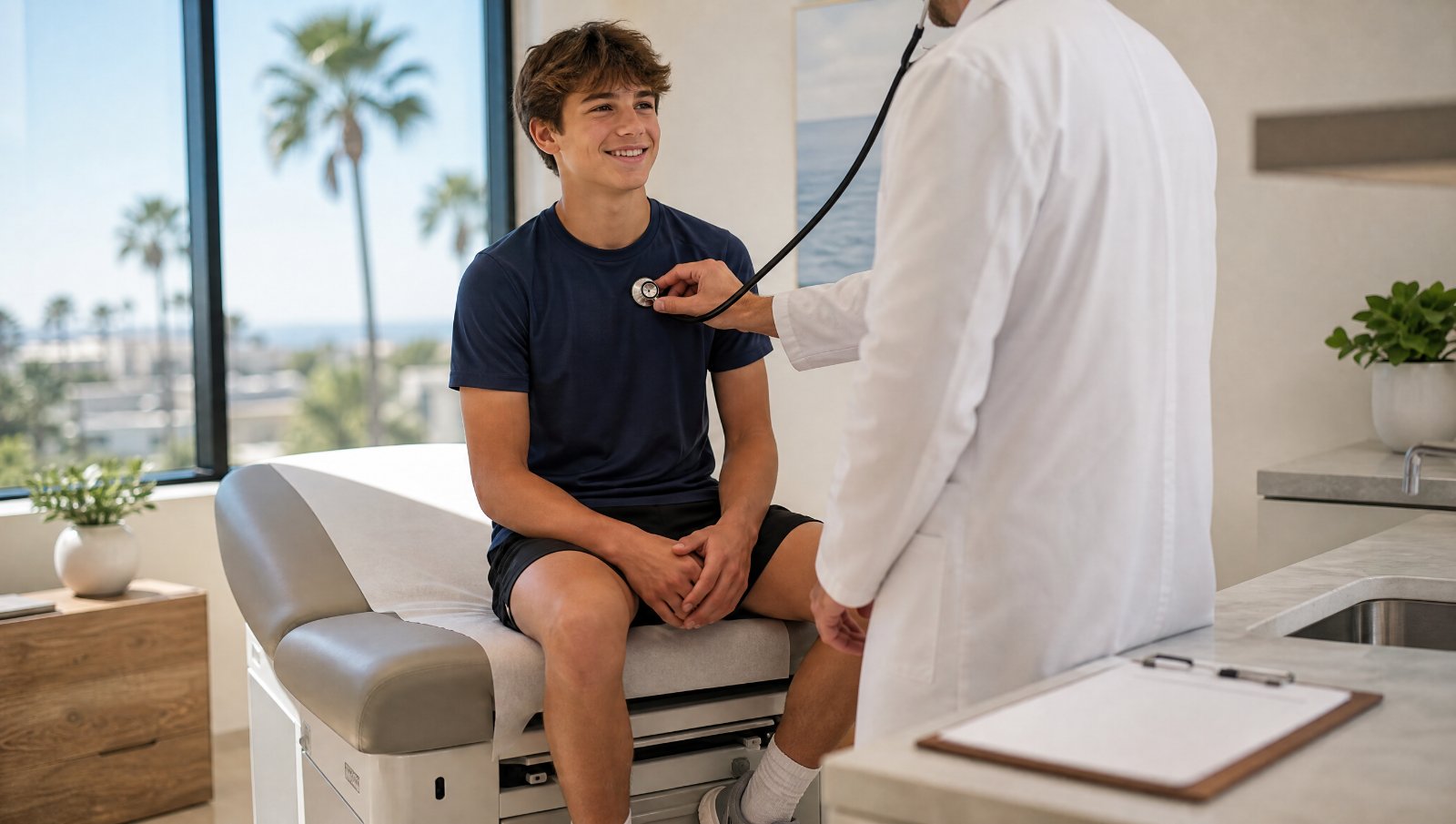
A sports physical is one of the few medical visits where the goal is not to find something wrong; the goal is to confirm a child is ready to safely train, compete, and recover. Most Newport Beach and Orange County schools require this clearance every academic year before a student can participate in athletic programs. The form is short. The visit, done well, is not.
Below is what happens during a thorough sports physical in our Newport Beach practice, what we look for that a 5-minute drive-through physical often misses, and how to prepare so your child’s clearance form is signed the same day.
The conversation that turned a routine sports physical into a life-saved one
In our practice, the question that catches a serious condition more than any other on the standardized form is: “Has anyone in your family ever passed away suddenly under the age of 55?”
That single question has, more than once, surfaced a family history of cardiac conditions or sudden cardiac death. When the answer is yes, the clearance does not get signed that day. We hold it, order an EKG/echocardiogram, and often refer to a pediatric cardiologist. A perfectly healthy 14-year-old can have a condition like hypertrophic cardiomyopathy or long QT syndrome, both of which can be silent until they are fatal.
What the AAP, AHA, and California schools require
The American Academy of Pediatrics Preparticipation Physical Evaluation, 5th Edition and the American Heart Association scientific statement on preparticipation cardiovascular screening recommend that every preparticipation physical evaluation cover six core areas: cardiovascular history, musculoskeletal history, neurological history (including concussion), respiratory history, vision and hearing, and a focused physical exam. California school districts, including Newport-Mesa Unified, Laguna Beach Unified, and Capistrano Unified, use a version of the standardized PPE-5 form that covers all six.
A thorough sports physical at Concierge Pediatrics takes 30 to 45 minutes and includes:
Cardiovascular screening. Resting heart rate, blood pressure in both arms, auscultation in two positions (supine and standing) to detect murmurs that change with posture, and a focused family history of sudden cardiac death, fainting during exercise, or unexplained seizures.
Musculoskeletal exam. A 90-second “duck walk” plus a joint range-of-motion screen to identify prior injuries that did not heal properly, asymmetry, and red flags for conditions like Osgood-Schlatter disease or spondylolysis in young athletes.
Neurological and concussion baseline. For contact sports, we document a baseline cognitive picture so that if a concussion happens during the season, recovery can be measured against the child’s own pre-injury function, not a population average. The CDC HEADS UP campaign provides the framework most pediatric practices follow for concussion recognition and return-to-play.
Vision, hearing, and respiratory. Snellen vision testing, audiometry when indicated, and a peak flow reading for any child with exercise-induced symptoms.
Growth and pubertal staging. Especially important for adolescents whose sport categories (weight class wrestling, gymnastics) intersect with growth velocity.
What separates a 5-minute physical from a real one
The standard PPE form takes about 5 minutes to fill in if you skip the conversation. Here are the four questions that, in our experience, catch the most missed conditions:
- “In the last 12 months, has your child had any symptom that you thought might be unusual but did not bring to a doctor?” This question surfaces palpitations, brief fainting episodes, exercise-triggered chest tightness, and post-exertion headaches that get dismissed as growing pains.
- “Has anyone in your immediate or extended family died suddenly, unexpectedly, or had a heart problem before age 50?” Family history of sudden cardiac death is the single most important screening question for hypertrophic cardiomyopathy and long QT syndrome.
- “What does your child eat in a typical day? Are they trying to gain or lose weight for their sport?” Disordered eating in adolescent athletes, especially in cross country, gymnastics, and wrestling, is more common than parents realize. The National Athletic Trainers’ Association position statement on disordered eating in athletes documents long-term effects on bone density and menstrual health.
- “How is sleep?” Peer-reviewed pediatric sports medicine research published in the Journal of Pediatric Orthopaedics found that adolescent athletes who slept fewer than 8 hours per night had approximately 1.7 times the injury risk of athletes who slept more. Sleep is the single most modifiable injury-prevention factor we discuss.
Red flags that should pause a clearance
Most sports physicals end with a signed form. Some should not. The following findings warrant further evaluation before clearance:
- A new heart murmur not previously documented, or any murmur that gets louder when the child stands
- A history of chest pain, shortness of breath, or fainting during or immediately after exercise
- A family history of sudden death before age 50, especially during physical activity
- A prior concussion in the last 6 months without a documented return-to-play protocol
- An untreated musculoskeletal injury from the previous season
- A blood pressure reading above the 95th percentile for age and height on two separate measurements
- Symptoms suggesting an eating disorder, such as menstrual irregularity in female athletes, rapid weight loss, or signs of restrictive eating
When any of these come up, we coordinate directly with the appropriate specialist. For cardiac concerns, that is usually a pediatric cardiologist at Children’s Hospital of Orange County (CHOC) or Hoag. For musculoskeletal issues, our colleagues at Hoag Orthopedic Institute. For concussion clearance, a sports medicine physician with a documented return-to-play protocol.

What parents can prepare before the visit
A productive sports physical visit starts before your child walks into the office. Here is what to bring or have ready:
- The school’s preparticipation form, partially filled in with personal and emergency contact information
- A list of any medications, including over-the-counter supplements and protein powders
- The dates of any prior concussions, injuries, surgeries, or hospitalizations
- Immunization records if the child has changed pediatricians recently
- A short family history, especially any sudden deaths, heart conditions, or seizure disorders
- Eyewear or contact lenses your child uses
- A discussion with your child about whether they feel ready to play, or whether something has been bothering them
If your child is being evaluated for a sport with a specific governing body (USA Swimming, USA Gymnastics, USA Wrestling), some events require additional screening forms or baseline neurocognitive testing. We can complete most of these in the same visit.
When the sports physical should not be combined with the annual well visit
A well-child visit and a sports physical have overlapping but distinct goals. The well visit screens for development, growth trends, mental health, and preventive immunization. The sports physical screens for cardiac, musculoskeletal, and neurological readiness for athletic exertion.
For elementary-school athletes, the two visits can often be combined into a single 45-minute appointment. For competitive middle school and high school athletes, especially those in contact or high-cardiovascular-demand sports, we generally recommend separating them so that neither set of questions gets shortened.
Frequently Asked Questions
When should we schedule our child’s sports physical?
Schedule the physical 4 to 6 weeks before the season starts. This gives enough time to follow up on any findings (an EKG referral, an orthopedic clearance, a vision correction) without missing tryouts.
Does a sports physical cover the school’s annual health requirement, or is a well visit also needed?
A sports physical covers athletic clearance only. California children still need their well-child visit, which is recommended annually by the AAP and required by most insurance plans for preventive coverage. They can be done together for younger children.
My child plays year-round travel sports. Do we need a sports physical every year?
Yes. Most California school districts and youth sports organizations require an updated physical every academic year. Some clubs require one every 6 months for athletes under 14.
What if my child has asthma or a heart condition already?
A pre-existing condition does not disqualify a child from sports; it changes what we monitor. For asthma, we confirm rescue inhaler access and exercise tolerance. For known cardiac conditions, we coordinate clearance directly with the child’s cardiologist before signing the form.
How long is a sports physical valid?
In California, a sports physical signed by a licensed physician is valid for the academic year in which it was completed and through the following summer, unless the school’s specific form states otherwise. Always check the school’s date requirement.
Ready for your child’s sports physical?
If your child is preparing for football, soccer, water polo, lacrosse, cross country, swimming, or any Newport Beach school sport this fall, book a 30 to 45 minute sports physical visit with Dr. Vivi. As a concierge pediatric practice, we offer same-week appointments and follow up directly with school athletic departments if any clearance steps are needed.
Ask Dr Vivi | Concierge Pediatrics
369 San Miguel Drive, Suite 370
Newport Beach, CA 92660
Phone: 949-324-0462
Book a Meet the Doc appointment
Related reading: Our pediatric services | How concierge pediatrics works in Orange County | Recommended pediatric well visits and screening
This article is for educational purposes only and is not a substitute for individualized medical advice. If you have specific concerns about your child’s readiness for sport, please book an appointment with Dr. Vivi or your child’s pediatrician.
References
- Bernhardt DT, Roberts WO, eds. Preparticipation Physical Evaluation, 5th Edition. American Academy of Pediatrics; 2019. ISBN 978-1-61002-301-6. https://publications.aap.org/aapbooks/book/656/Preparticipation-Physical-Evaluation-5th-Ed
- Maron BJ, Levine BD, Washington RL, et al. Eligibility and Disqualification Recommendations for Competitive Athletes With Cardiovascular Abnormalities: Task Force 2: Preparticipation Screening for Cardiovascular Disease in Competitive Athletes. Circulation. 2015;132:e267-e272. DOI: 10.1161/CIR.0000000000000238. https://www.ahajournals.org/doi/10.1161/cir.0000000000000238
- Centers for Disease Control and Prevention. HEADS UP: Concussion in Youth Sports. https://www.cdc.gov/heads-up/
- Milewski MD, Skaggs DL, Bishop GA, et al. Chronic Lack of Sleep is Associated With Increased Sports Injuries in Adolescent Athletes. Journal of Pediatric Orthopaedics. 2014;34(2):129-133. DOI: 10.1097/BPO.0000000000000151. PubMed: 25028798. https://pubmed.ncbi.nlm.nih.gov/25028798/
- Bonci CM, Bonci LJ, Granger LR, et al. National Athletic Trainers’ Association Position Statement: Preventing, Detecting, and Managing Disordered Eating in Athletes. Journal of Athletic Training. 2008;43(1):80-108. DOI: 10.4085/1062-6050-43.1.80. https://pubmed.ncbi.nlm.nih.gov/18335017/